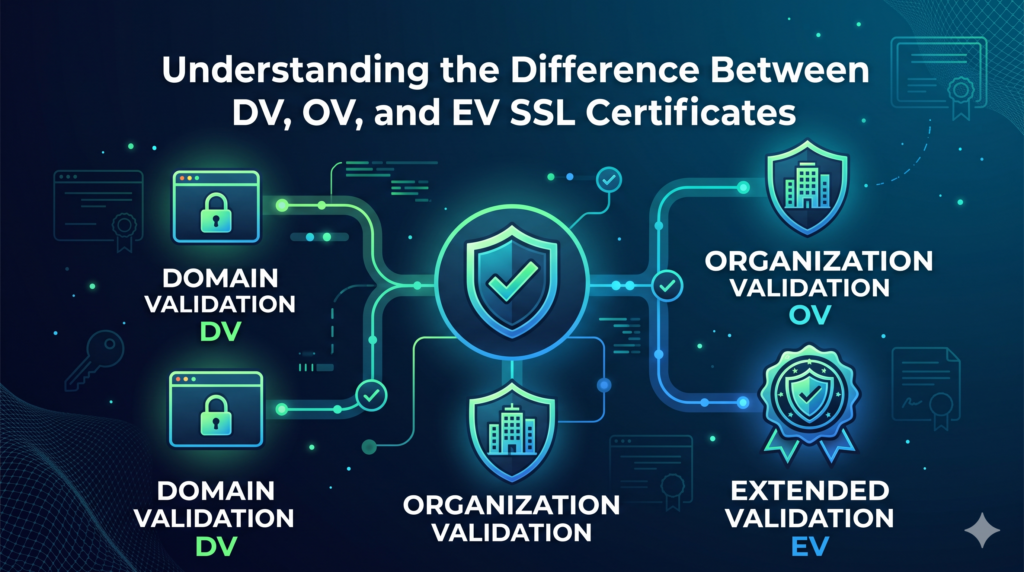
When evaluating DV vs OV vs EV SSL certificates, implementing HTTPS is non-negotiable. While every certificate provides robust cryptographic encryption, the level of verified business identity and organizational trust varies significantly across validation tiers.
Many site owners assume all certificates offer identical protection because they all activate the browser connection security padlock. However, understanding the practical trade-offs in DV vs OV vs EV SSL certificates is critical to avoiding brand impersonation, passing enterprise security audits, and protecting customer transactions.
In this definitive guide, we break down the core differences in DV vs OV vs EV SSL certificates. You’ll learn how each validation tier works, their issuance timelines, warranty scales, cost implications, and how to select the ideal certificate for your infrastructure.

Quick Comparison: DV vs OV vs EV SSL at a Glance
| Feature / Criteria | Domain Validation (DV) | Organization Validation (OV) | Extended Validation (EV) |
|---|---|---|---|
| Primary Purpose | Basic encryption & connection security | Verified business identity + strong encryption | Maximum corporate trust & anti-phishing protection |
| Identity Verification | Domain ownership only | Domain control + legal business entity check | Rigorous multi-step corporate audit & legal verification |
| Issuance Speed | ⚡ 2 to 15 minutes | ⏱️ 1 to 3 business days | ⏱️ 1 to 5 business days |
| Vetting Rigor | Automated (DNS / Email / HTTP) | Manual + official corporate registry cross-checks | In-depth legal, physical, and operational verification |
| Browser Indicator | Secure padlock / HTTPS | Padlock + verified identity in certificate details | Padlock + organizational identity in certificate metadata |
| Trust Seal | Static site seal | Dynamic, clickable site seal with company info | High-assurance dynamic seal with live verification |
| Warranty Range | $10,000 – $50,000 | $50,000 – $1,000,000 | $1,000,000 – $2,000,000+ |
| Ideal For | Blogs, personal portfolios, internal test sites | Mid-market businesses, B2B portals, SaaS login pages | Banks, large e-commerce platforms, enterprise brands |
How Does Cryptographic Encryption Work Across Tiers?
A common misconception in web security is that higher-tier certificates provide “stronger encryption.” In reality, the cryptographic strength of DV, OV, and EV is identical. All three validation levels use the same industry-standard TLS protocols (TLS 1.2 and TLS 1.3), cipher suites (AES-128, AES-256, ChaCha20), and asymmetric key lengths (2048-bit to 4096-bit RSA or 256-bit to 384-bit ECDSA).
The level of mathematical encryption does not change across certificate tiers. A $20 DV certificate encrypts data in transit just as effectively as a $300 EV certificate.
The true differentiator is identity assurance. Encryption guarantees that data cannot be intercepted or tampered with by eavesdroppers, but it does not authenticate who controls the server on the other end:
DV answers: “Is the communication with this domain encrypted?” (Yes, but anyone could own it).
OV answers: “Does an actual, legally registered company own this encrypted domain?”
EV answers: “Has this business undergone an exhaustive identity audit confirming its corporate status, physical address, and right to operate?”
1. Domain Validation (DV) SSL Certificates: Fast, Automated Security
What Is a DV Certificate?
A Domain Validation (DV) SSL certificate is an entry-level certificate designed to encrypt communications between a web browser and a single apex or subdomain. The Certificate Authority (CA) verifies only one criterion: that the applicant has administrative control over the registered domain name.
Comodo PositiveSSL Certificate
DOMAIN VALIDATION (DV)- ✓ Automated 5-minute issuance with zero paperwork
- ✓ Full 256-bit encryption with multi-year savings
- ✓ $10,000 warranty & trusted by millions of websites
How Verification Works:
The CA verifies ownership using one of three automated challenge-response methods:
- Email Verification: An authorization email is sent to administrative addresses on the domain (
admin@,webmaster@, or WHOIS contacts). - DNS TXT Record: You add a unique cryptographic verification hash provided by the CA into your public DNS records.
- HTTP File Upload: You upload a designated verification file containing a security nonce to a well-known directory (
/.well-known/pki-validation/) on your web server.
Pros of DV:
- Instant Issuance: Provisioned within minutes via fully automated systems.
- No Paperwork: No government registration, articles of incorporation, or notarized paperwork required.
- Cost-Effective: Accessible pricing suitable for lean budgets.
Cons of DV:
- Zero Identity Vetting: Criminals and phishing operators can obtain DV certificates effortlessly for lookalike domains (e.g.,
paypal-security-login.com). - Minimal Warranty: Backed by modest warranties (typically $10,000 to $50,000).
- Unsuitable for E-Commerce: Fails to provide corporate legitimacy for consumer-facing transaction portals.
Best Use Cases for DV:
- Personal blogs, hobby projects, and informational websites.
- Internal testing environments, staging servers, and non-sensitive staging APIs.
- Startups launching landing pages where no user authentication or payment processing occurs.
2. Organization Validation (OV) SSL Certificates: Verified Business Identity
What Is an OV Certificate?
An Organization Validation (OV) SSL certificate offers high-assurance encryption backed by human-verified corporate authentication. In addition to proving domain ownership, your business must prove it is a legally registered, active commercial enterprise.
When visitors inspect your certificate details, your official company name, jurisdiction, and city are cryptographically stamped into the subject fields, assuring customers they are dealing with a legitimate organization.
How Verification Works:
The Certificate Authority conducts a thorough corporate vetting process:
- Domain Ownership Verification: The same automated domain control check as DV.
- Legal Registry Check: The CA searches official government registries (such as state corporate registries, Companies House, or Dun & Bradstreet) to verify legal existence and active status.
- Physical & Operational Address: The business address listed must match public business directories.
- Telephone Verification Call: The CA places a verification call to an independently verified telephone number from an accredited third-party directory (e.g., Dun & Bradstreet or YellowPages) to confirm the applicant is an authorized corporate representative.
Pros of OV:
- Distinguishes Your Site from Phishing Clones: Legitimate business details are visible inside certificate properties.
- Higher Warranty Protection: Offers substantial liability warranties from $50,000 up to $1,000,000.
- Dynamic Trust Seals: Provides interactive site seals displaying live verification timestamps and legal corporate names.
Cons of OV:
- Manual Verification: Requires 1 to 3 business days for human validation agents to review records.
- Documentation Required: Unregistered businesses or sole proprietors without formal registration cannot qualify.
- Higher Price Point: Priced higher than DV certificates due to manual human auditing costs.
Best Use Cases for OV:
- B2B SaaS platforms and member login portals.
- Corporate websites, university portals, and non-profit donor platforms.
- Mid-market online stores collecting customer registration data and recurring payments.
3. Extended Validation (EV) SSL Certificates: Maximum Trust & Protection
What Is an EV Certificate?
An Extended Validation (EV) SSL certificate represents the gold standard of digital trust. Established under strict, standardized guidelines by the CA/Browser Forum, EV requires an exhaustive legal, physical, and operational audit before issuance.
How Verification Works:
The CA conducts a rigorous multi-step corporate audit:
- Verification of Legal, Physical, and Operational Existence: The organization must be officially registered with active standing, have an operational physical office, and have confirmed operational presence.
- Cross-Verification with Official Filings: The CA inspects primary state corporate databases, tax registers, and corporate charter documents.
- Exclusive Right to the Domain: Strict verification that the corporate entity holds exclusive legal rights to the registered domains.
- Direct Officer Verification: The CA conducts a direct telephone interview with an authorized executive officer (e.g., HR Director, CEO, or Legal Counsel) to verify the signatory authority.
Pros of EV:
- Maximum Consumer Trust: Demonstrates an elite commitment to customer security and fraud prevention.
- Anti-Phishing Defense: Makes it virtually impossible for malicious actors to impersonate your enterprise brand.
- Highest Warranties: Enterprise warranties typically range from $1,000,000 to over $2,000,000+.
- High-Impact Dynamic Site Seals: Dynamic site seals allow customers to verify live corporate credentials before completing major purchases.
Cons of EV:
- Longer Turnaround: The auditing process typically requires 1 to 5 business days.
- Strict Eligibility: Incomplete government records or unlisted company phone lines can delay approval.
- No Wildcards: Under CA/Browser Forum rules, EV Wildcard certificates are not permitted (though EV Multi-Domain SAN certificates are supported).
Best Use Cases for EV:
- Financial institutions, banking portals, and investment management platforms.
- High-volume e-commerce brands where cart abandonment directly impacts revenue.
- Global enterprise brands frequently targeted by brand hijacking and credential phishing scams.
Technical Comparison: How Browsers Display DV, OV, and EV
Browser representations of SSL/TLS have evolved. In earlier browser generations, EV certificates displayed a distinctive “green address bar” containing the legal company name.
To improve UI consistency and address mobile screen constraints, modern browsers (Chrome, Edge, Firefox, Safari) have standardized the main address bar interface across all certificates:
DV CERTIFICATE DETAILS
OV / EV CERTIFICATE DETAILS
Where Identity Information Shows Today:
- The Modern Padlock / Tune Icon: When a user clicks the connection security icon in modern browsers, they can click into the Certificate Information pane.
- Certificate Subject Data:
- On a DV certificate, the “Subject” field only lists the domain name.
- On an OV or EV certificate, the “Subject” field lists the full legal company name, incorporated jurisdiction, corporate registration number, and operating city.
- Dynamic Trust Seals: Embedded site seals display real-time verification modals directly on checkout screens, maintaining conversion rates without relying solely on the browser URL bar.
Decision Framework: Which DV vs OV vs EV SSL Certificate Should You Choose?
Choose Domain Validation (DV) if:
- You need an active HTTPS connection within 15 minutes.
- You run personal projects, developer sandboxes, or simple blogs.
- You do not process transactions or collect confidential corporate data.
Choose Organization Validation (OV) if:
- You run a registered commercial company, school, hospital, or government entity.
- You host customer login dashboards, SaaS web apps, or internal business portals.
- You want to clearly separate your corporate domain from phishing lookalikes.
Choose Extended Validation (EV) if:
- You process high-volume credit card or banking transactions.
- Your brand identity is actively vulnerable to counterfeiting, phishing, and scam domains.
- You require enterprise-level liability insurance ($1M+) for operational risk management.
Frequently Asked Questions (FAQ)
Does an EV certificate improve Google SEO rankings more than a DV certificate?
No. Google’s HTTPS ranking signal treats all valid SSL/TLS certificates equally. Google evaluates whether the connection is served securely over HTTPS, not whether the validation tier is DV, OV, or EV.
Can individuals or freelancers buy an OV or EV certificate?
Generally, no. Both OV and EV require the applicant to be a verified legal business entity registered in official government or state databases. Sole proprietors can occasionally qualify if they hold verifiable local business licenses and registration certificates, but standard DV certificates are the standard choice for individual operators.
Can I get an EV Wildcard SSL certificate?
No. Under the CA/Browser Forum Extended Validation Guidelines, EV Wildcard certificates are not permitted. If you require an EV certificate, you must specify exact Fully Qualified Domain Names (FQDNs). However, you can use an EV Multi-Domain (SAN) certificate to secure dozens of distinct hostnames under a single EV audit. If you must secure unlimited subdomains automatically, an OV Wildcard or DV Wildcard is required.
What happens if my business details change during the certificate validity period?
If your legal business name or physical jurisdiction changes, you must request a certificate reissue from your Certificate Authority. Because the cryptographic metadata within OV and EV certificates contains immutable corporate information, a new CSR and validation pass are required to update the public record.
Final Recommendation
When deciding between DV vs OV vs EV SSL certificates, securing your web properties is about balancing operational speed, technical requirements, and public trust. For a broader pre-purchase architectural evaluation, check out our guide on the 10 critical questions to ask before buying an SSL certificate.
- For basic websites, informational publishing, and early-stage MVPs, a Domain Validation (DV) certificate offers the fastest and most cost-effective path to HTTPS compliance.
- For commercial enterprises, SaaS platforms, and internal business networks, an Organization Validation (OV) certificate is the professional baseline, providing verified corporate identity and higher financial warranty protection.
- For financial portals, high-volume e-commerce stores, and high-visibility corporate brands, an Extended Validation (EV) certificate delivers unmatched anti-phishing defense and maximum consumer confidence.
Ready to secure your domains? Browse our full SSL certificate catalog for industry-leading pricing on Sectigo and DigiCert certificates, or use our 30-second interactive SSL Wizard to identify the perfect validation tier for your organization.
Secure Your Website at Wholesale Rates with PositiveSSL
Get authorized platinum distributor pricing with automated instant issuance, 24/7 engineer support, and a risk-free 30-day money-back guarantee.